
 a
Three rulers set out
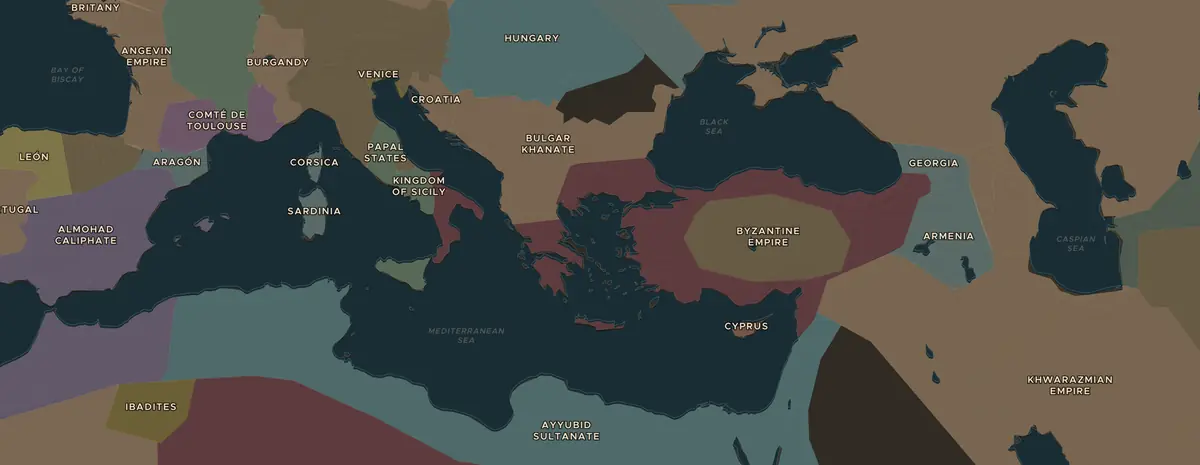
Open the map in 1190 and zoom out over Europe. Find the Angevin Empire, the Kingdom of France and the Holy Roman Empire. Which army had the longest road to the east?
Open this view on the mapCrusades · 1187-1192
After Saladin takes Jerusalem in 1187, the kings of England and France and the German emperor set out to win it back. Students follow the Third Crusade by land and sea, meet Richard and Saladin through the sources, and ask why it ended in a truce.
A call from history · new
Early July 1192
The crusader camp near Beit Nuba, west of Jerusalem
“You must decide whether to lead your army to attack Jerusalem or to turn back to the coast. The city is the main goal of the crusade, but your army is weakened by disease and short on supplies. If you attack, you risk being trapped far from your fleet and cut off from help. If you turn back, you may disappoint your men and your supporters at home.”
Should I order an attack on Jerusalem, or should I retreat to the coast and seek a truce? The caller speaks English, in their own voice, from a short brief of textbook facts, knows nothing of what came later and never tells the outcome; the screen does, after the call. On the live board the telephone rings the whole class: the teacher answers on the room's microphone, and students write to the caller from their phones.
Calls come with Pro (5 a month) and Classroom (20 a month, ringing the whole class). How calls work
Live lesson · new in Classroom
Put the board on the projector. Students join with a six-digit code, no account needed, and tap the map: where was the frontier, where did the grain come from. Their pins drop in together when you reveal, and the closest student takes the round.
€19 per month: every lesson live, every worksheet, cancel anytime. Rome at its height runs live for free.


Or as homework · new
The same 7 rounds, without the board: each student walks through them alone on their phone, sees every answer at once with the explanation, and the report fills in as they go. Open for a week, with a code and a link you can paste anywhere.
Homework comes with Classroom, like the live lesson. The free lesson can be set as homework by everyone.


 CrusadesRichard the Lionheart and the Third Crusade
Slides · new
22 slides: the plate, the 3 map steps with their pictures and a link to the live map, the discussion questions, the quiz with the answer on the next slide, and the worksheet. Speaker notes carry what to say. It is a .pptx, so it opens in PowerPoint, Keynote and Google Slides, and you can change anything.
€19 per month: the deck of every lesson, every worksheet, every live lesson. Rome at its height comes whole for free.
Read aloud
After Saladin takes Jerusalem in 1187, the kings of England and France and the German emperor set out to win it back. Students follow the Third Crusade by land and sea, meet Richard and Saladin through the sources, and ask why it ended in a truce.
By the end of the lesson, students can
Project the map, or let students follow on their own devices. Each step opens the map at the right year and place.
a
Open the map in 1190 and zoom out over Europe. Find the Angevin Empire, the Kingdom of France and the Holy Roman Empire. Which army had the longest road to the east?
Open this view on the map
b
Follow Richard's fleet from Marseille past Sicily and Cyprus to the coast of the Holy Land. Turn on Historical Events and find the Siege of Acre. Why did sea power matter so much?
Open this view on the map
c
Zoom in on the coast between Acre and Jaffa. The crusaders marched south with the sea on their right and the fleet beside them. Why stay so close to the coast?
Open this view on the mapPick two or three. They run from what happened to why it mattered.
Play Rule History as Saladin. Let the class decide how to answer three invading rulers. Afterwards, compare with what Saladin did: he wore the crusaders down, kept Jerusalem and finally agreed to a truce with Richard.
Open Rule History€19 per month unlocks every worksheet, the slides of every lesson, every live lesson and the class workspace. The free lesson prints without a subscription.