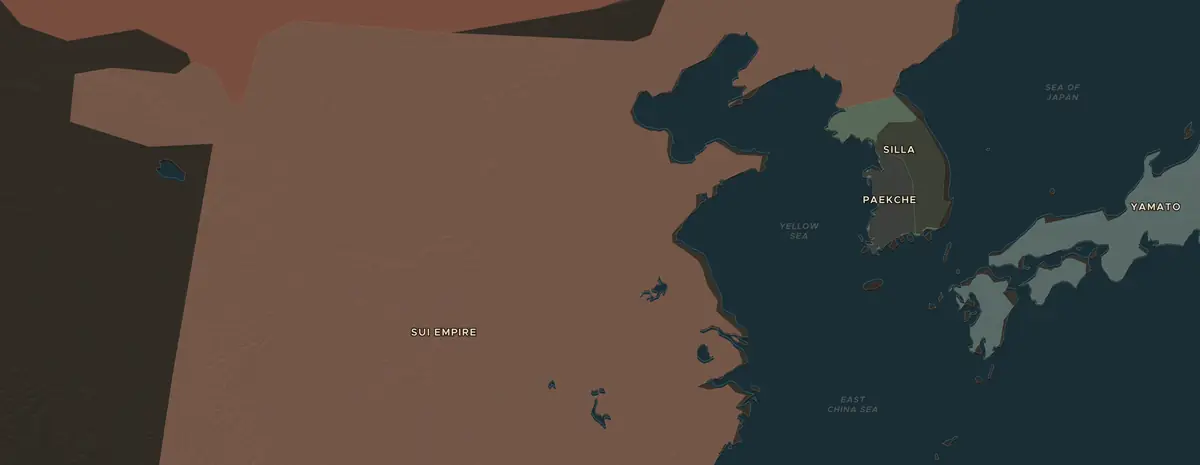
Sui dynasty · 604-618

The Sui and the Grand Canal

In 589 the Sui reunited a China that had been split for centuries. Emperor Yang then joined its great rivers with the Grand Canal. Students trace the canal on the map and weigh a project that helped build China and helped bring down its builder.

Duración
50 minutos
Edades
11–14
En el mapa
3 pasos, 540 d. C. a 610 d. C.
Lección en directo
7 rondas, 3 en el mapa
Tarea
Las mismas rondas, durante una semana
Hoja de trabajo
Dos páginas A4, con Classroom
Diapositivas
22 diapositivas, con Classroom
Necesitas
Un proyector; móviles para la versión en directo
Lámina 159Sui dynasty, 610 d. C.. Las letras señalan los tres pasos en el mapa de esta lección.

Una llamada de la historia · nuevo

Emperor Yang of Sui está al teléfono. La clase decide.

Spring, 610
Luoyang, Sui China

“You must decide whether to continue using large numbers of conscripted laborers to finish the Grand Canal quickly, or slow the work to reduce hardship on the people. Finishing fast will connect the empire’s north and south, but forced labor has already caused suffering and unrest. Delaying the canal may ease resentment, but risks losing control and support from officials and the army.”

Should I keep pushing the canal to finish quickly, or slow down to protect my people from hardship? La persona que llama habla inglés, con su propia voz, siguiendo una breve ficha de hechos históricos, sin saber nada de lo que ocurrió después ni contar el desenlace; la pantalla lo revela tras la llamada. En la pizarra en directo suena el teléfono para toda la clase: el profesor responde con el micrófono del aula y los alumnos escriben al personaje desde sus móviles.

Inicia sesión para atender la llamada

Las llamadas están incluidas en Pro (5 al mes) y Classroom (20 al mes, para toda la clase). Cómo funcionan las llamadas

Lección en directo · nuevo en Classroom

Enséñala en directo. La clase responde desde sus móviles.

Proyecta la pizarra. Los alumnos entran con un código de seis cifras, sin cuenta, y marcan en el mapa: dónde estaba la frontera, de dónde venía el grano. Al mostrar la respuesta, caen todos los pines y gana el alumno más cercano.

19 € al mes: todas las lecciones en directo, todas las fichas, cancela cuando quieras. Roma en su máximo esplendor funciona en directo gratis.

Una clase en directo en el proyector: los pines de la clase en el mapa alrededor de Alejandría, con los alumnos más cercanos al lado. En el móvil del alumno: la pregunta y un mapa para responder tocando.
7 rondas
3 lugares en el mapa, preguntas tipo test, una votación y una respuesta breve.
Unos 15 minutos
Úsalo como paso del mapa o para iniciar el debate. Avanza con la barra espaciadora.
Un informe
Todas las respuestas, por alumno y por ronda, para revisar o imprimir después.

O como tarea · nuevo

¿No tienes tiempo en clase? Ponlo como tarea.

Las mismas 7 rondas, sin pizarra: cada alumno las hace solo en su móvil, ve todas las respuestas y explicaciones al momento, y el informe se completa a medida que avanzan. Disponible una semana, con un código y un enlace para compartir donde quieras.

La tarea está incluida en Classroom, igual que la clase en directo. Todos pueden poner la lección gratuita como tarea.

Sui dynastyThe Sui and the Grand Canal

Diapositivas · nuevo

Toda la lección en un solo archivo.

22 diapositivas: la portada, los 3 pasos del mapa con sus imágenes y un enlace al mapa interactivo, las preguntas para debatir, el cuestionario con la respuesta en la siguiente diapositiva y la ficha de actividades. Las notas del orador incluyen sugerencias para explicar. Es un archivo .pptx, así que se abre en PowerPoint, Keynote y Google Slides, y puedes modificar lo que quieras.

Vista previa: las primeras 4 diapositivas

19 € al mes: todas las presentaciones, todas las fichas y todas las clases en directo. Roma en su máximo esplendor incluye todo gratis.

1

Introducción

5 min

Leer en voz alta

In 589 the Sui reunited a China that had been split for centuries. Emperor Yang then joined its great rivers with the Grand Canal. Students trace the canal on the map and weigh a project that helped build China and helped bring down its builder.

Al terminar la lección, los alumnos podrán

  • Explain why the reunification of China in 589 needed new ways to connect north and south.
  • Trace the Grand Canal on the map from the Yangtze to the Yellow River and beyond.
  • Weigh the costs and benefits of Emperor Yang's building projects and wars.
2

Explora el mapa

15 min

Proyecta el mapa o deja que los alumnos lo sigan en sus dispositivos. Cada paso abre el mapa en el año y lugar correctos.

El mapa en 540 d. C. a

540 d. C.

One empire again

Open the map in 540 and look at China: it is split between northern and southern states. Now drag the time slider to 600. What has changed, and why would one ruler now need to connect north and south?

Abrir esta vista en el mapa
El mapa en 610 d. C. b

610 d. C.

Two great rivers

Jump to 610 and zoom in between the Yellow River in the north and the Yangtze in the south. Both flow from west to east. Why did the Sui need a waterway running north to south between them?

Abrir esta vista en el mapa
El mapa en 610 d. C. c

610 d. C.

The ends of the canal

Find Hangzhou in the south and the area of modern Beijing in the north, the two ends of the later Grand Canal. The canal is about 1,800 km long. Why is it so much longer than the straight line between them?

Abrir esta vista en el mapa
3

Debate en clase

15 min

Elige dos o tres. Van desde qué pasó hasta por qué fue importante.

  1. For centuries China had been split between north and south. What did the Sui achieve in 589, and why was it hard to keep the country together afterwards?
  2. The south grew more rice, but the capitals and the armies were in the north. How did the Grand Canal solve this problem?
  3. Emperor Yang used forced labor on a huge scale. How do you think ordinary families felt about his projects?
  4. Why did three failed wars against the Korean kingdom of Goguryeo weaken the Sui so badly?
  5. The Sui lasted only 37 years, but parts of its canal still carry boats today. How should we judge a ruler whose projects outlive him?
4

Ronda de juego

10 min

Rule History has no Sui ruler, so play Wu Zetian, who ruled China about 70 years later. Let students take turns making rulings about building projects and wars. Then compare: would Emperor Yang have made the same choices, and what did they cost him?

Abrir Rule History
5

Hoja de trabajo

5 min

Esta ficha está incluida en Classroom

Por 19 € al mes tienes todas las fichas, las diapositivas de cada lección, todas las clases en directo y el espacio de trabajo de la clase. La lección gratuita se imprime sin suscripción.