Ghana Empire · about 700-1200

The Ghana Empire: land of gold

Long before the modern country of Ghana, an empire called Wagadu grew rich at the southern end of the Saharan trade. Students read what an Arab geographer wrote in 1068 and learn how a king controlled gold he did not mine.

Length
45 minutes
Ages
11–14
On the map
3 steps, AD 1000 to AD 1279
Live lesson
7 rounds, 3 on the map
Homework
The same rounds, a week long
Worksheet
Two A4 pages, with Classroom
Slides
22 slides, with Classroom
You need
A projector; phones for live
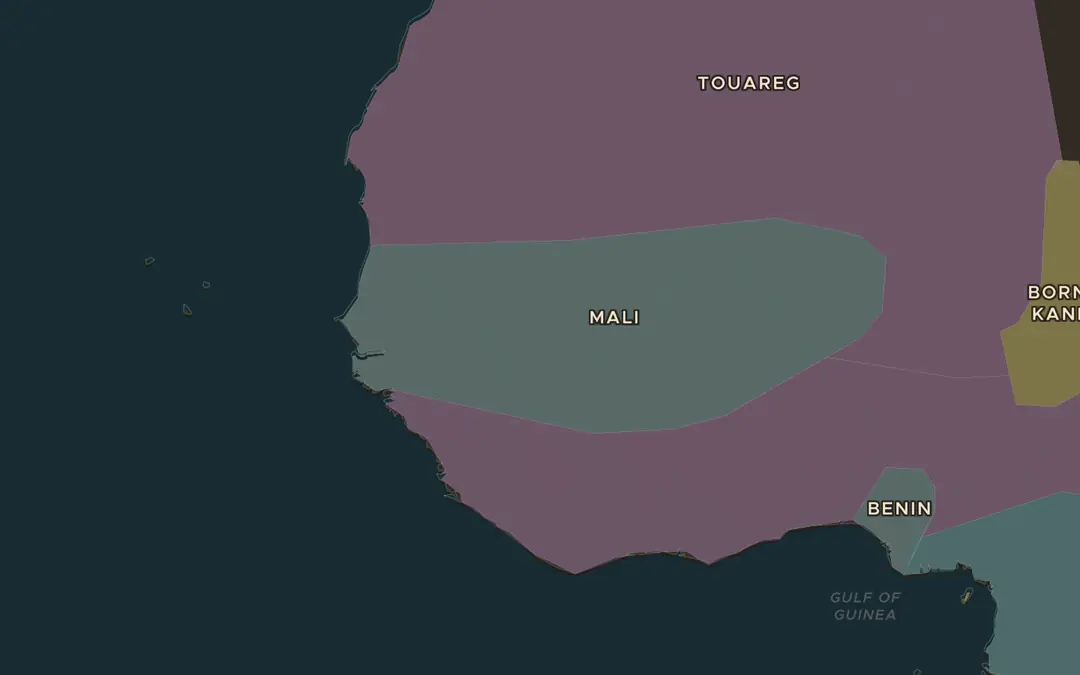
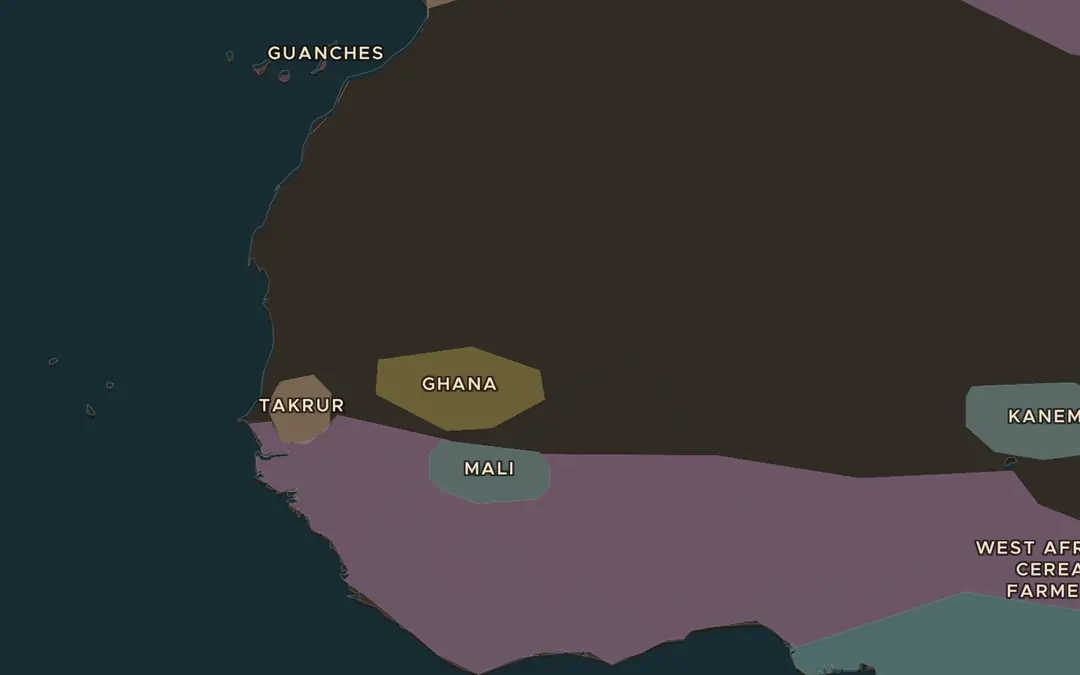
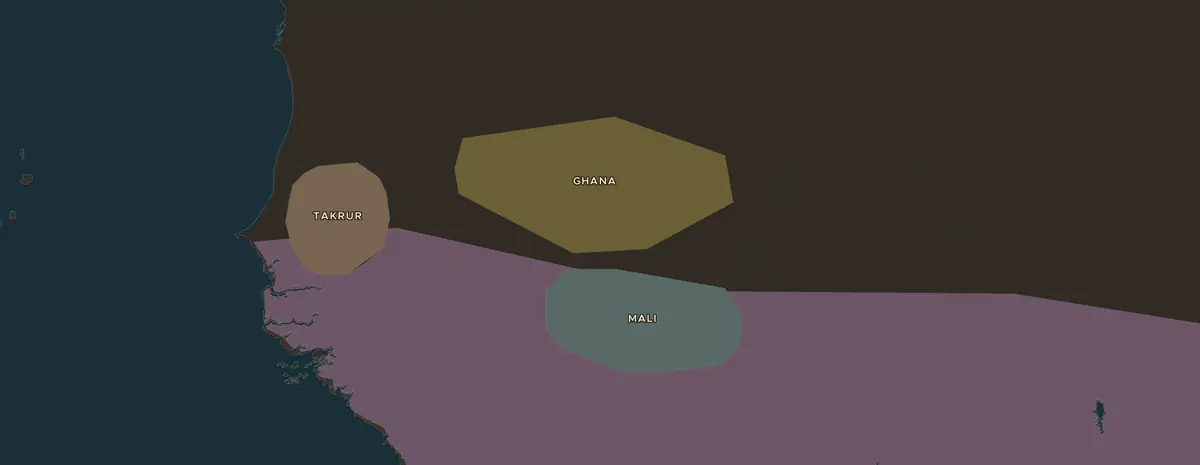
Plate 212Ghana Empire, AD 1000. The letters mark the three map steps of this lesson.

A call from history · new

Tunka Menin is on the line. The class decides.

The height of my reign, about 1068
Koumbi Saleh, capital of the Ghana Empire

“You must decide how to manage relations between the Muslim merchants and your own people, who follow the traditional religion. If you favor the merchants too much, your people may be upset. If you ignore the merchants, you risk losing trade and wealth. You must balance both groups to keep peace and prosperity.”

Should I allow Muslim merchants to have their own town and mosques, or should I insist everyone follow our traditional ways? The caller speaks English, in their own voice, from a short brief of textbook facts, knows nothing of what came later and never tells the outcome; the screen does, after the call. On the live board the telephone rings the whole class: the teacher answers on the room's microphone, and students write to the caller from their phones.

Sign in to take the call

Calls come with Pro (5 a month) and Classroom (20 a month, ringing the whole class). How calls work

Live lesson · new in Classroom

Teach it live. The class answers on their phones.

Put the board on the projector. Students join with a six-digit code, no account needed, and tap the map: where was the frontier, where did the grain come from. Their pins drop in together when you reveal, and the closest student takes the round.

€19 per month: every lesson live, every worksheet, cancel anytime. Rome at its height runs live for free.

A live lesson on the projector: the class's pins on the map around Alexandria, the closest students listed beside it A student's phone: the question and a map to tap
7 rounds
3 places to find on the map, quiz questions, a class vote and a one-line answer.
About 15 minutes
Run it as the map step, or to open the discussion. You move on with the space bar.
A report
Every answer, per student and per round, to read back or print after the lesson.

Or as homework · new

No lesson hour to spare? Set it as homework.

The same 7 rounds, without the board: each student walks through them alone on their phone, sees every answer at once with the explanation, and the report fills in as they go. Open for a week, with a code and a link you can paste anywhere.

Homework comes with Classroom, like the live lesson. The free lesson can be set as homework by everyone.

Ghana EmpireThe Ghana Empire: land of gold

Slides · new

The whole lesson as a deck.

22 slides: the plate, the 3 map steps with their pictures and a link to the live map, the discussion questions, the quiz with the answer on the next slide, and the worksheet. Speaker notes carry what to say. It is a .pptx, so it opens in PowerPoint, Keynote and Google Slides, and you can change anything.

Preview: the first 4 slides

€19 per month: the deck of every lesson, every worksheet, every live lesson. Rome at its height comes whole for free.

1

Introduction

5 min

Read aloud

Long before the modern country of Ghana, an empire called Wagadu grew rich at the southern end of the Saharan trade. Students read what an Arab geographer wrote in 1068 and learn how a king controlled gold he did not mine.

By the end of the lesson, students can

  • Locate the Ghana Empire and explain why it is not in the same place as the modern country of Ghana.
  • Explain how the king of Ghana grew rich by taxing trade and controlling gold nuggets.
  • Judge the value and limits of al-Bakri's description as a historical source.
2

Explore the map

12 min

Project the map, or let students follow on their own devices. Each step opens the map at the right year and place.

The map in AD 1000 a

AD 1000

Where Ghana really was

Open the map in 1000 and find the label Ghana in the dry Sahel north of the Senegal and Niger rivers. Then drag the slider to 2000: the modern country of Ghana appears far to the south-east. Why might it have taken the old name?

Open this view on the map
The map in AD 1000 b

AD 1000

At the edge of the desert

Back in 1000, turn on Trade Routes. How close is Ghana to the route across the Sahara? Which goods could its king tax?

Open this view on the map
The map in AD 1279 c

AD 1279

A new power

Drag the slider slowly from 1100 to 1279 and watch the labels. Which empire takes Ghana's place?

Open this view on the map
3

Class discussion

14 min

Pick two or three. They run from what happened to why it mattered.

  1. The name "Ghana" was really the title of the king. Why might outsiders name a whole country after its ruler?
  2. The king taxed salt coming in and going out. Why was taxing trade a smarter idea than mining gold himself?
  3. Much of what we know comes from al-Bakri, who never went there. How reliable is a writer who collects other people's stories?
  4. The king's town and the Muslim merchants' town stood side by side. What does this tell us about religion in Ghana?
  5. Historians argue about whether the Almoravids conquered Ghana around 1076. Why do historians disagree about events so long ago?
4

Game round

9 min

No ruler of Ghana is in Rule History. Play one round as Charlemagne, who ruled in Europe while Ghana was growing rich, and compare: where did each ruler's wealth come from, land or trade?

Open Rule History
5

Worksheet

5 min

This worksheet comes with Classroom

€19 per month unlocks every worksheet, the slides of every lesson, every live lesson and the class workspace. The free lesson prints without a subscription.