
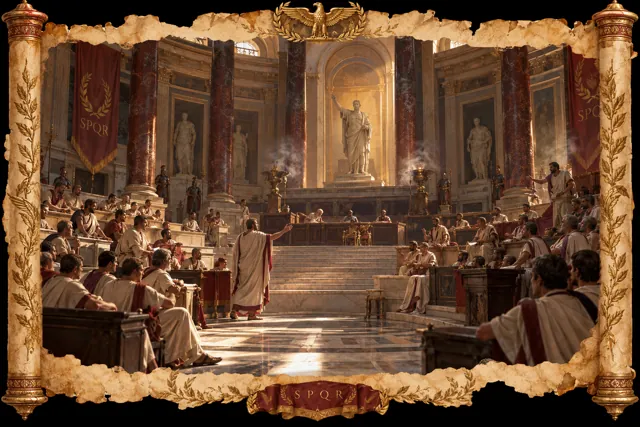
 a
A city in the desert
Open the map in AD 250 and turn on the Cities layer. Find Palmyra in the Syrian desert, between the Mediterranean and the Euphrates. Why would a city grow at an oasis here?
Open this view on the mapRoman Empire · 260-273 AD
A caravan city in the Syrian desert became the center of a realm stretching from Egypt to Asia Minor. Students follow Queen Zenobia's rise and fall and ask how Romans and Syrians have told her story.
A call from history · new
The night after the defeat near Emesa
A camp outside Emesa, Syria
“You must decide whether to stay in Emesa and try to defend the city, risking capture, or retreat toward Palmyra to gather more forces and supplies. If you flee too soon, your supporters may lose faith. If you stay too long, you may be trapped by the Roman army.”
Should I stay in Emesa and defend, or withdraw to Palmyra to regroup? The caller speaks English, in their own voice, from a short brief of textbook facts, knows nothing of what came later and never tells the outcome; the screen does, after the call. On the live board the telephone rings the whole class: the teacher answers on the room's microphone, and students write to the caller from their phones.
Calls come with Pro (5 a month) and Classroom (20 a month, ringing the whole class). How calls work
Live lesson · new in Classroom
Put the board on the projector. Students join with a six-digit code, no account needed, and tap the map: where was the frontier, where did the grain come from. Their pins drop in together when you reveal, and the closest student takes the round.
€19 per month: every lesson live, every worksheet, cancel anytime. Rome at its height runs live for free.


Or as homework · new
The same 7 rounds, without the board: each student walks through them alone on their phone, sees every answer at once with the explanation, and the report fills in as they go. Open for a week, with a code and a link you can paste anywhere.
Homework comes with Classroom, like the live lesson. The free lesson can be set as homework by everyone.


 Roman EmpireZenobia, queen of Palmyra
Slides · new
22 slides: the plate, the 3 map steps with their pictures and a link to the live map, the discussion questions, the quiz with the answer on the next slide, and the worksheet. Speaker notes carry what to say. It is a .pptx, so it opens in PowerPoint, Keynote and Google Slides, and you can change anything.
€19 per month: the deck of every lesson, every worksheet, every live lesson. Rome at its height comes whole for free.
The Senate · AD 249
That the Senate accept the emperor Philip's offer to lay down the empire, unless it will give him real help against the revolts on the Danube and in Syria.
The class speaks as Marcus Julius Philippus against Gaius Messius Quintus and Fulvius Aemilianus, who answer aloud in their own voices and vote at the end. Two speeches are free; with Pro or Classroom the floor is yours. The Senate speaks English.
Real motion from AD 249. Put the Senate on the projector and let the class argue it out, then compare with what happened.
Read aloud
A caravan city in the Syrian desert became the center of a realm stretching from Egypt to Asia Minor. Students follow Queen Zenobia's rise and fall and ask how Romans and Syrians have told her story.
By the end of the lesson, students can
Project the map, or let students follow on their own devices. Each step opens the map at the right year and place.
a
Open the map in AD 250 and turn on the Cities layer. Find Palmyra in the Syrian desert, between the Mediterranean and the Euphrates. Why would a city grow at an oasis here?
Open this view on the map
b
Turn on Trade Routes and follow the routes that come from the east toward Syria. Which goods might caravans have carried through Palmyra?
Open this view on the map
c
The map shows the empire in one piece, but in 271 Zenobia ruled from Egypt to central Asia Minor. With the Cities layer, find Alexandria, Antioch and Palmyra. How long might a messenger take to ride between them?
Open this view on the mapPick two or three. They run from what happened to why it mattered.
Play the Cleopatra VII round in Rule History, the queen Zenobia is said to have admired. Discuss: Cleopatra and Zenobia both challenged Rome from the east. What did they have in common, and why did both lose?
Open Rule History€19 per month unlocks every worksheet, the slides of every lesson, every live lesson and the class workspace. The free lesson prints without a subscription.