Alexander: an empire in ten years
From a small Greek kingdom to the edge of India in a decade. Students follow the campaign route and discover why the empire broke apart just as fast.
Learning objectives
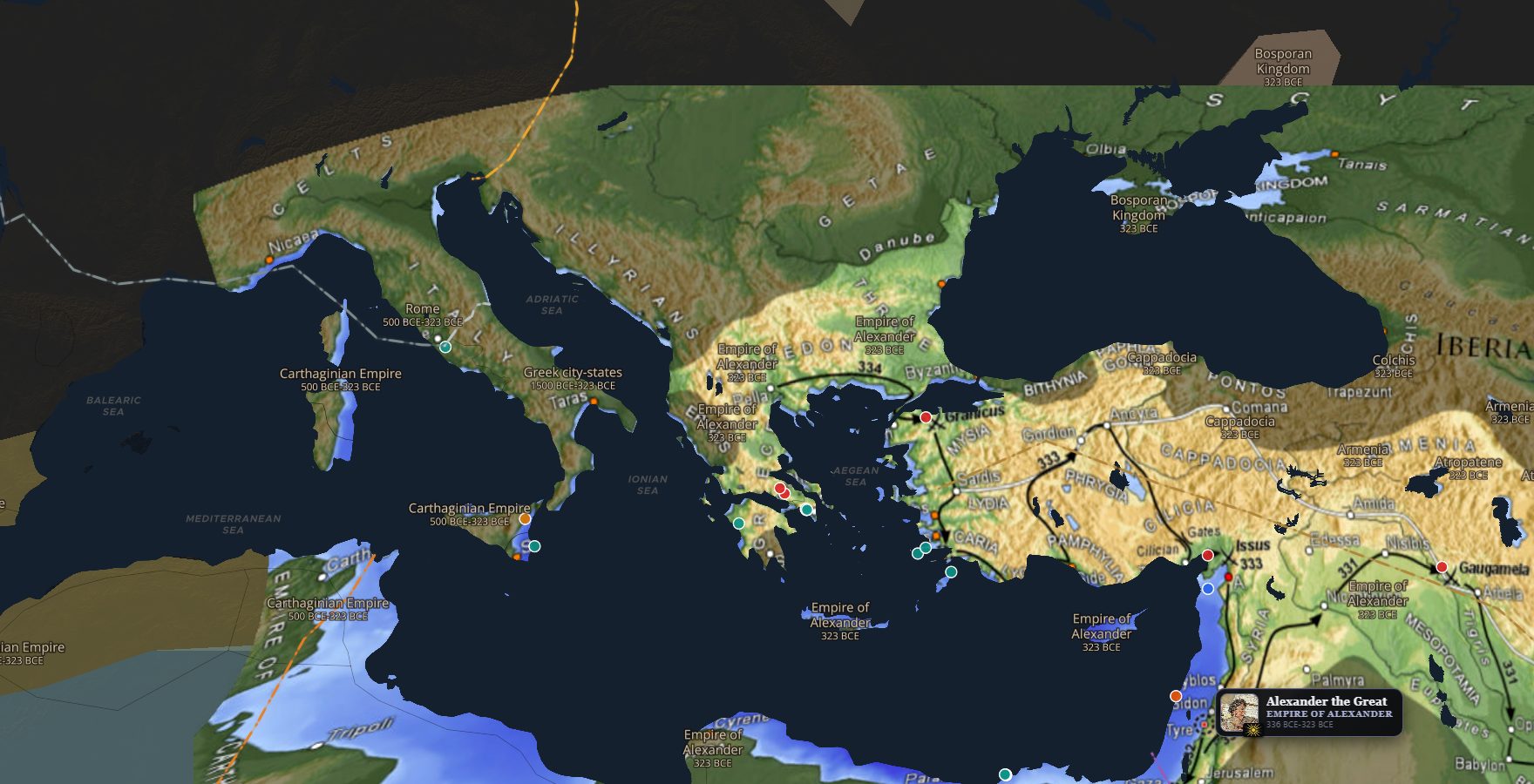
- Trace Alexander's campaign route from Macedonia to India on the map.
- Explain why his empire fell apart after his death.
- Give one example of Greek influence that stayed behind in Asia (Hellenism).
On the map
Open the map in 336 BC on Macedonia. Compare its size with the Persian Empire to the east. What would you have advised the young king?
Open the map here336 BC
Open the Journeys layer and follow Alexander's route. Count the cities named Alexandria that he founded.
Open the map here330 BC
Jump to 300 BC. The empire is split between his generals. Name the two biggest successor kingdoms.
Open the map here300 BC
Discussion questions
- Alexander founded over twenty cities named after himself. Smart policy or vanity?
- His soldiers refused to go further at the river in India. Were they right?
- Why did such a huge empire depend so much on one person?
- Greek became a world language for centuries after Alexander. How does a language spread with an army?
- Who deserves the title "the Great" more: someone who conquers an empire or someone who keeps one running?
Game round
Rule History: set the era to the Hellenistic world. Students play one ruling each as a successor king (Diadoch) and explain how their choice would keep Greek culture alive far from Greece.
Open Rule HistoryWorksheet
This worksheet is part of Classroom
Unlock every worksheet, ad-free classes and assignable games for €19 per month. The free lesson's worksheet prints without a subscription.