Sui dynasty · 604-618

The Sui and the Grand Canal

In 589 the Sui reunited a China that had been split for centuries. Emperor Yang then joined its great rivers with the Grand Canal. Students trace the canal on the map and weigh a project that helped build China and helped bring down its builder.

Duur
50 minuten
Leeftijd
11–14
Op de kaart
3 stappen, 540 n.Chr. tot 610 n.Chr.
Live les
7 rondes, 3 op de kaart
Huiswerk
Dezelfde rondes, een week lang
Werkblad
Twee A4’s, bij Classroom
Dia’s
22 dia’s, bij Classroom
Je hebt nodig
Een beamer; telefoons voor live
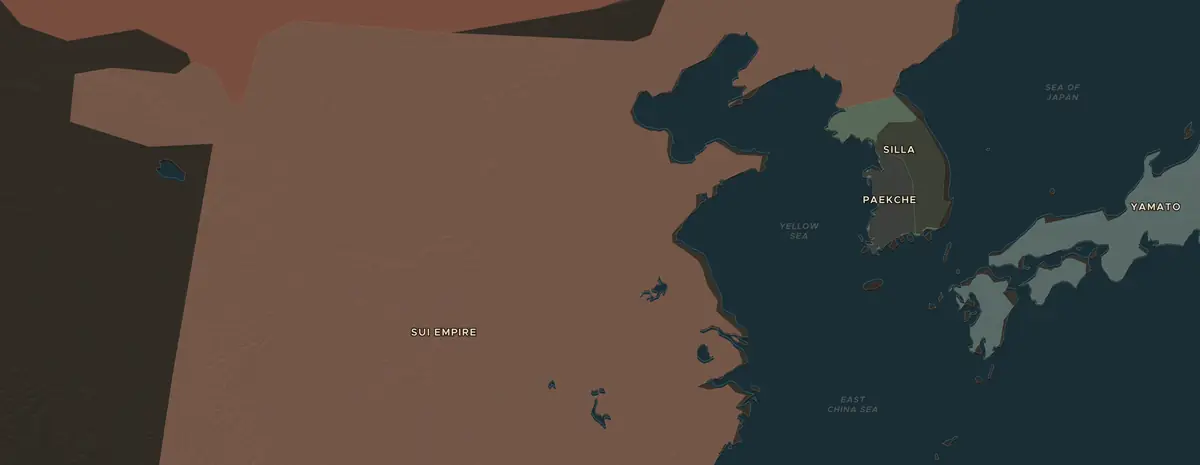
Kaartplaat 159Sui dynasty, 610 n.Chr.. De letters geven de drie kaartstappen van deze les aan.

Een telefoontje uit het verleden · nieuw

Emperor Yang of Sui hangt aan de lijn. De klas beslist.

Spring, 610
Luoyang, Sui China

“You must decide whether to continue using large numbers of conscripted laborers to finish the Grand Canal quickly, or slow the work to reduce hardship on the people. Finishing fast will connect the empire’s north and south, but forced labor has already caused suffering and unrest. Delaying the canal may ease resentment, but risks losing control and support from officials and the army.”

Should I keep pushing the canal to finish quickly, or slow down to protect my people from hardship? De beller spreekt Engels, met zijn of haar eigen stem, vanuit een korte samenvatting van feiten uit het lesboek, weet niets van wat later gebeurde en vertelt nooit de afloop; dat zie je na het gesprek op het scherm. Op het livebord rinkelt de telefoon voor de hele klas: de docent neemt op via de microfoon, leerlingen sturen hun antwoord via hun telefoon.

Log in om het telefoontje op te nemen

Telefoontjes zitten bij Pro (5 per maand) en Classroom (20 per maand, voor de hele klas). Hoe telefoontjes werken

Live les · nieuw in Classroom

Geef live les. De klas antwoordt via hun telefoon.

Zet het bord op de beamer. Leerlingen doen mee met een zescijferige code, geen account nodig, en tikken op de kaart: waar lag de grens, waar kwam het graan vandaan. Hun pins verschijnen tegelijk als je onthult, en de leerling die het dichtstbij zit wint de ronde.

€19 per maand: elke les live, alle werkbladen, maandelijks opzegbaar. Rome op zijn grootst loopt gratis live.

Een live les op het digibord: de pins van de klas op de kaart rond Alexandrië, met de dichtstbijzijnde leerlingen ernaast. Op de telefoon van de leerling: de vraag en een kaart om op te tikken.
7 rondes
3 plekken zoeken op de kaart, quizvragen, een klassenstemming en een kort antwoord.
Ongeveer 15 minuten
Gebruik het als kaartopdracht of als start van het gesprek. Je gaat verder met de spatiebalk.
Een rapport
Alle antwoorden, per leerling en per ronde, om terug te lezen of te printen na de les.

Of als huiswerk · nieuw

Geen lestijd over? Zet het als huiswerk klaar.

Dezelfde 7 rondes, zonder digibord: elke leerling doorloopt ze zelf op de telefoon, ziet meteen alle antwoorden met uitleg, en het rapport vult zich automatisch. Een week open, met een code en een link die je overal kunt delen.

Huiswerk hoort bij Classroom, net als de live les. De gratis les kan iedereen als huiswerk geven.

Sui dynastyThe Sui and the Grand Canal

Dia’s · nieuw

De hele les als presentatie.

22 slides: het titelblad, de 3 kaartstappen met afbeeldingen en een link naar de live kaart, de gespreksvragen, de quiz met het antwoord op de volgende slide, en het werkblad. In de sprekersnotities staat wat je kunt zeggen. Het is een .pptx, dus werkt in PowerPoint, Keynote en Google Slides, en je kunt alles aanpassen.

Voorbeeld: de eerste 4 slides

€19 per maand: de presentatie van elke les, alle werkbladen, elke live les. Rome op zijn grootst is helemaal gratis beschikbaar.

1

Introductie

5 min

Lees voor

In 589 the Sui reunited a China that had been split for centuries. Emperor Yang then joined its great rivers with the Grand Canal. Students trace the canal on the map and weigh a project that helped build China and helped bring down its builder.

Aan het eind van de les kunnen leerlingen

  • Explain why the reunification of China in 589 needed new ways to connect north and south.
  • Trace the Grand Canal on the map from the Yangtze to the Yellow River and beyond.
  • Weigh the costs and benefits of Emperor Yang's building projects and wars.
2

Ontdek de kaart

15 min

Projecteer de kaart, of laat leerlingen zelf meekijken. Elke stap opent de kaart op het juiste jaar en de juiste plek.

De kaart in 540 n.Chr. a

540 n.Chr.

One empire again

Open the map in 540 and look at China: it is split between northern and southern states. Now drag the time slider to 600. What has changed, and why would one ruler now need to connect north and south?

Open dit beeld op de kaart
De kaart in 610 n.Chr. b

610 n.Chr.

Two great rivers

Jump to 610 and zoom in between the Yellow River in the north and the Yangtze in the south. Both flow from west to east. Why did the Sui need a waterway running north to south between them?

Open dit beeld op de kaart
De kaart in 610 n.Chr. c

610 n.Chr.

The ends of the canal

Find Hangzhou in the south and the area of modern Beijing in the north, the two ends of the later Grand Canal. The canal is about 1,800 km long. Why is it so much longer than the straight line between them?

Open dit beeld op de kaart
3

Klassengesprek

15 min

Kies er twee of drie. Ze gaan van wat er gebeurde naar waarom het belangrijk was.

  1. For centuries China had been split between north and south. What did the Sui achieve in 589, and why was it hard to keep the country together afterwards?
  2. The south grew more rice, but the capitals and the armies were in the north. How did the Grand Canal solve this problem?
  3. Emperor Yang used forced labor on a huge scale. How do you think ordinary families felt about his projects?
  4. Why did three failed wars against the Korean kingdom of Goguryeo weaken the Sui so badly?
  5. The Sui lasted only 37 years, but parts of its canal still carry boats today. How should we judge a ruler whose projects outlive him?
4

Spelronde

10 min

Rule History has no Sui ruler, so play Wu Zetian, who ruled China about 70 years later. Let students take turns making rulings about building projects and wars. Then compare: would Emperor Yang have made the same choices, and what did they cost him?

Open Rule History
5

Werkblad

5 min

Dit werkblad hoort bij Classroom

Voor €19 per maand krijg je alle werkbladen, slides van elke les, elke live les en het klaslokaal. De gratis les kun je altijd printen.